
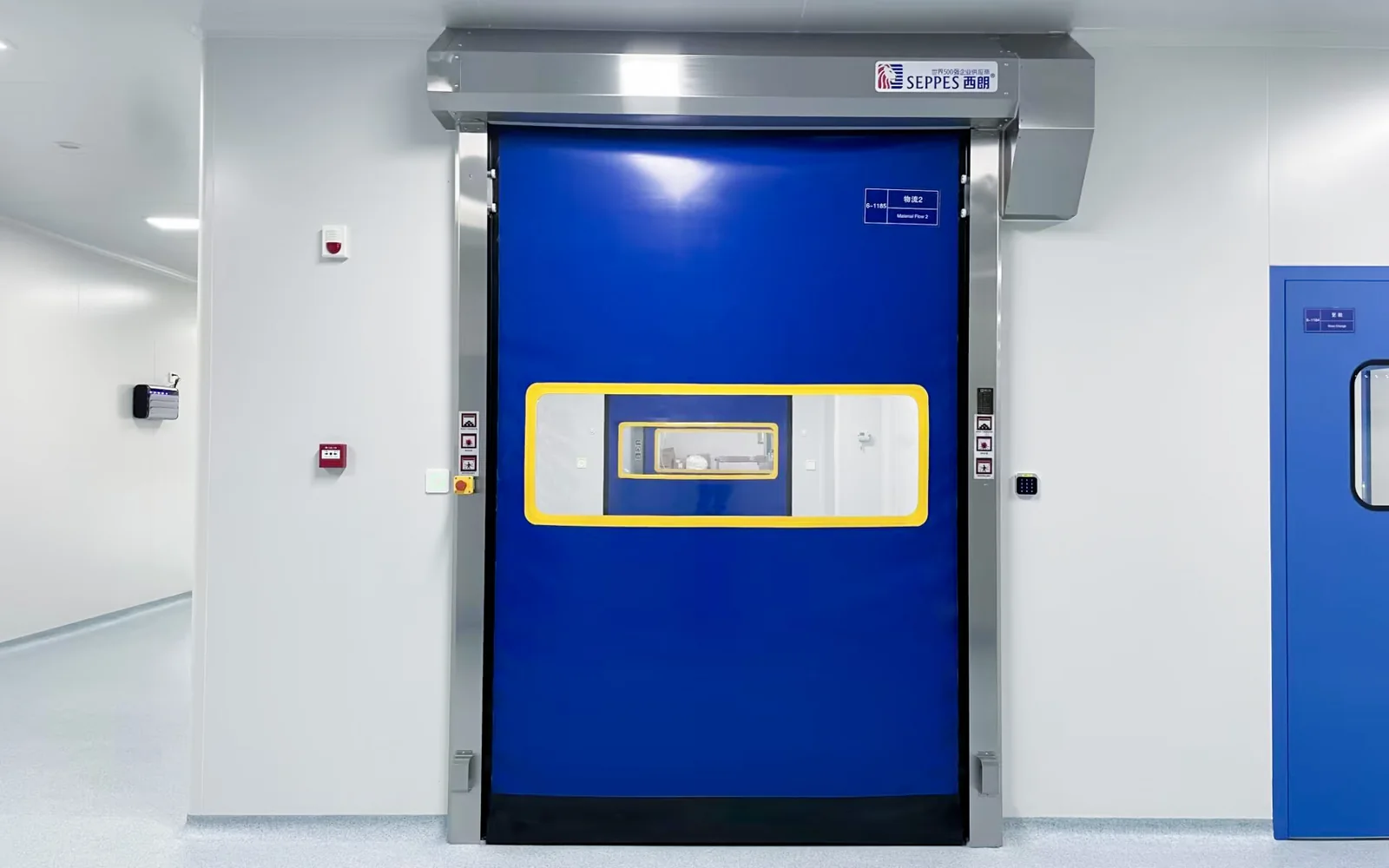
A cleanroom doorway must support frequent movement without becoming an uncontrolled break in the room boundary. A zipper high-speed door can shorten open time, retain the flexible curtain inside interlocking side guides and, on suitable configurations, guide a displaced curtain back into position after an impact. The correct selection still depends on the room pressure strategy, traffic, cleaning method, safety concept and installed-system validation.
Quick answer
Why use a zipper high-speed door for a cleanroom?
A zipper high-speed door combines rapid automatic operation with an interlocking curtain-edge guide, helping reduce unnecessary open time and maintain more continuous side engagement when closed. It can suit frequent cleanroom material or personnel routes, but the selected model, seals, materials, controls and interlocks must match the facility's pressure, cleaning, traffic and validation requirements.- Primary benefit
- Shorter open time
- Side guide
- Interlocking zipper edge
- Project focus
- Pressure + traffic + cleaning
- System boundary
- Supports, not replaces, HVAC
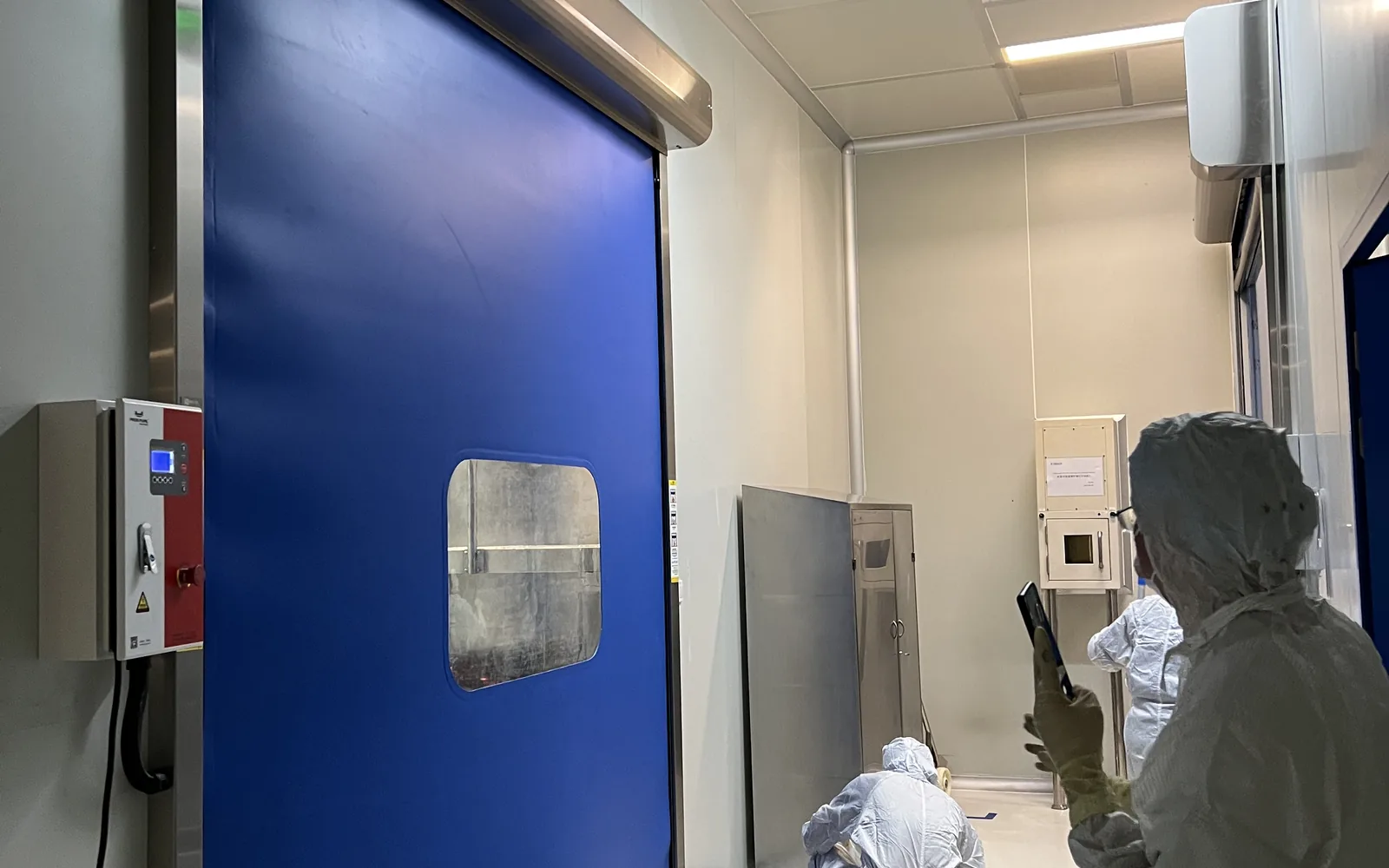
The cleanroom doorway is a moving environmental boundary
Every door cycle temporarily connects two spaces. The longer and more often the opening remains exposed, the more opportunity there is for air, particles, temperature and people or equipment to move across the boundary. Pressure direction and airflow are controlled by the wider facility, but the door affects how long that boundary is open.
A suitable cleanroom entrance therefore balances rapid access with predictable closing, perimeter engagement and safe detection. Selecting only by nominal speed can create unnecessary activation, poor clearance or a closing delay that leaves the room open longer than expected.
- Frequent material transfers interrupt room separation
- Pressure differences can influence curtain behaviour
- Forklifts, carts and AGVs require enough safe clearance
- Cleaning chemicals may affect curtains, windows and seals
- Manual doors may remain open for operator convenience
- Airlocks need defined normal, fault and emergency sequences
Common cleanroom access pain points
A door problem is often a system problem. Repeated alarms, doors held open, damaged curtains or unstable pressure may come from the traffic route, detection zone, ventilation balance or recovery procedure rather than one component alone.
| Pain point | Operational effect | Review first |
|---|---|---|
| Door stays open too long | Longer environmental exposure | Detection area, traffic and closing delay |
| Pressure disturbs the curtain | Unstable movement or sealing | Pressure direction, magnitude and selected construction |
| Forklift contact displaces the curtain | Downtime and boundary loss | Route width, protection and recovery design |
| Residue collects around guides | Cleaning and hygiene concern | Joint geometry, access and material compatibility |
| Unintended sensor activation | Excess cycles and open time | Approach direction and detection zoning |
| Airlock sequence is bypassed | Both boundaries may open | Workflow, permissions, faults and emergency release |
How the zipper guide supports cleanroom access
A zipper door uses shaped curtain edges that engage inside matching side guides. This creates a more continuous mechanical relationship between the curtain and tracks than a loose curtain running beside brush strips. The arrangement can be useful where perimeter control and recovery after an accidental impact are important selection factors.
The guide principle alone does not prove a leakage class, pressure rating or cleanroom classification. Those claims require evidence for the actual door construction and test scope. Buyers should compare the proposed guide, curtain, bottom edge, head assembly and frame as one system.
A useful answer
The proposal identifies the selected guide and curtain, explains recovery limits and supplies applicable evidence for the required boundary condition.
Follow up when
The supplier promises an airtight cleanroom door based only on the word zipper, without model-specific test scope.
Match each SEPPES zipper-door advantage to a requirement
SEPPES configures zipper high-speed doors around the opening, traffic and control requirements. The buyer should connect each available feature to a defined project need rather than treating every option as mandatory.
| Door feature | Buyer value | Confirm for the project |
|---|---|---|
| Rapid automatic movement | Shorter waiting and open time | Traffic speed, frequency and closing logic |
| Interlocking side guides | More continuous curtain-edge engagement | Pressure behaviour and applicable leakage evidence |
| Impact recovery on suitable models | Faster recovery after curtain displacement | Permitted impact, reinsertion method and inspection |
| Configurable activation | Hands-free or controlled access | People, carts, forklifts, AGVs and detection zones |
| Control interfaces | Coordination with airlocks or equipment | Signals, permissions, timeouts and fault response |
| Project-specific materials | Fit with cleaning and room conditions | Grades, chemicals, concentrations and contact time |
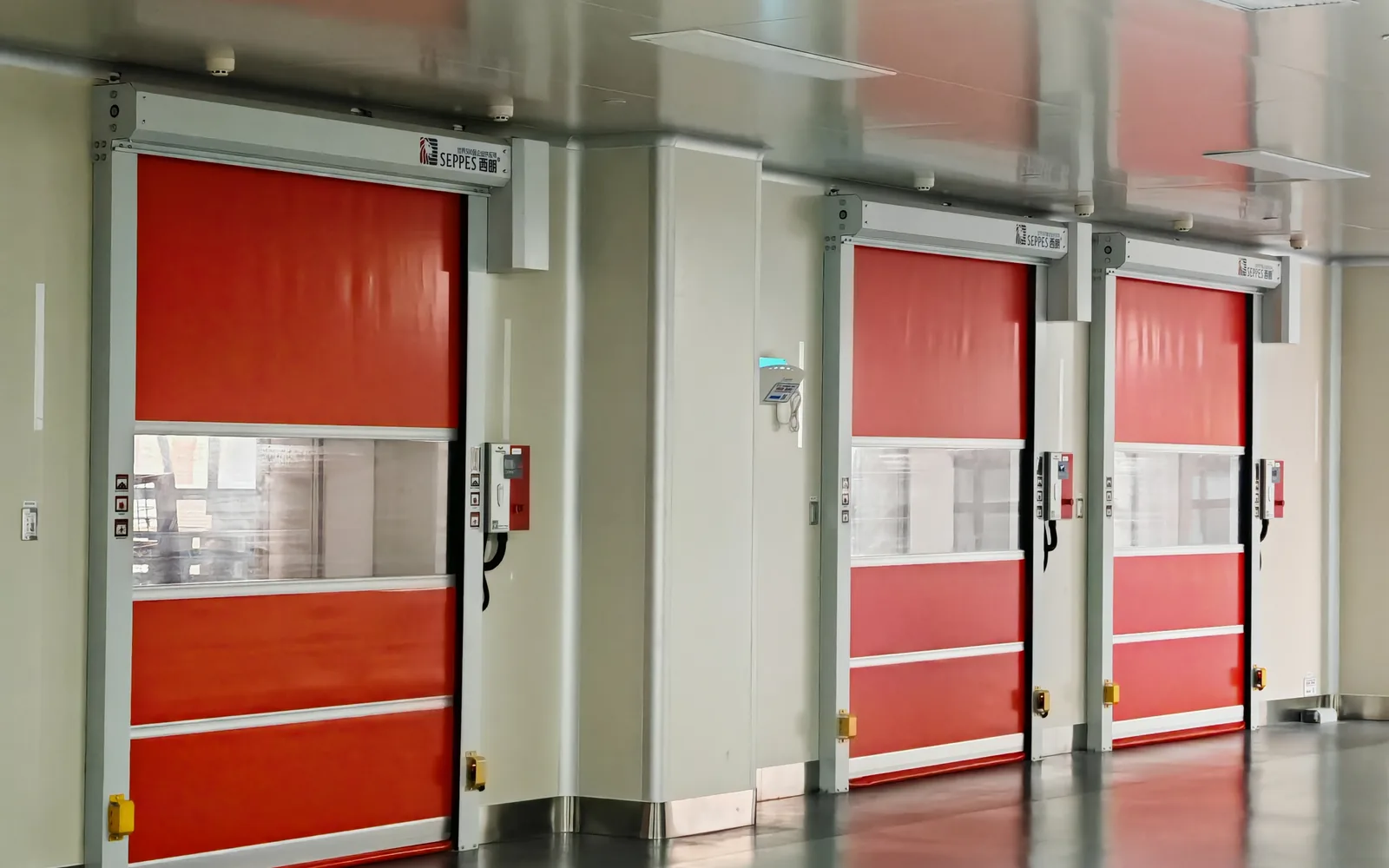
Resolve pressure, sealing and ventilation together
Positive or negative room pressure is established by the ventilation system. The door should be selected and adjusted for the stated pressure direction and operating condition, but it cannot correct inadequate airflow balance or replace filtration and extraction.
Ask how the curtain behaves while closed and during movement, which seals are included and what evidence applies to the proposed size. Where two controlled boundaries form an airlock, define whether one door must be confirmed closed before the other receives permission to open.
Plan cleaning and material compatibility
Clean-looking stainless steel does not establish cleaning suitability by itself. Review the frame grade and finish together with the curtain, window, zipper edge, seals, fasteners and control enclosure. Identify the actual cleaning chemical, concentration, temperature, contact time and rinse method.
The layout should allow access to guides, joints and wear parts without creating an impractical maintenance procedure. Any food-contact, antimicrobial or special hygiene claim should be supported by applicable documentation for the material and intended use.
- List every exposed material and finish.
- Compare materials with the facility's cleaning chemicals.
- Check access around guides, seals and the bottom edge.
- Define inspection and replacement of wear parts.
- Include cleaning guidance in the handover package.
Protect people, vehicles and the cleanroom process
Activation and protection perform different jobs. A radar may request opening, while photocells, safety edges or presence detection protect the passage according to their defined coverage. Mixed pedestrian and vehicle traffic may require separate routes, warning devices or additional detection after a site-specific assessment.
For an automated route, document the opening request, open-position confirmation, closing permission and fault response. A machine or AGV should not move merely because an open command was sent; it should wait for the agreed safe-position feedback.
Use a cleanroom selection brief before requesting a proposal
A clear brief allows SEPPES to review the zipper-door configuration, controls, documentation and limits against the actual room boundary. Include the facility and validation teams before the control sequence is finalized.
- Room purpose and adjacent areas
- Cleanliness, zoning and validation requirements
- Pressure direction and normal operating condition
- Opening width, height, headroom and side room
- Personnel, carts, forklifts, conveyors or AGV traffic
- Operating frequency and peak movement periods
- Cleaning method and chemical compatibility
- Activation, access control and safety devices
- Airlock or equipment-integration sequence
- Required drawings, evidence and handover records
Choose the cleanroom door as part of the complete system
A zipper high-speed door is a strong candidate when frequent access, controlled side engagement and recoverability are important. Final selection should follow the verified room design and the evidence available for the proposed construction.
Send SEPPES the opening dimensions, room use, pressure strategy, traffic, cleaning method, control sequence, project location and available drawings. The engineering review can then connect the door configuration to the cleanroom process without overpromising what one doorway can achieve.
Cleanroom Zipper Door Questions
Does a zipper high-speed door make a room a cleanroom?
No. The door supports the room boundary, but cleanroom performance depends on the complete enclosure, HVAC, filtration, pressure control, cleaning procedures, personnel practices and validation plan.
Does a zipper guide provide an airtight seal?
Do not infer an airtightness class from the guide name alone. Ask for leakage or pressure evidence that applies to the selected door size, curtain, guides, seals and test conditions.
Can a zipper door repair itself after an impact?
Some zipper configurations can guide a displaced curtain edge back into the tracks during the next operating cycle. Confirm that recovery is included in the proposed model and inspect the curtain, guides and safety functions after an impact.
Can two cleanroom doors be interlocked?
Yes, where the facility strategy requires it. Define the normal sequence, release conditions, timeout, fault response and emergency access with the facility and safety teams before production.
What information is needed to select the door?
Provide room use, cleanliness or zoning requirements, pressure direction, opening size, traffic, operating frequency, cleaning chemicals, activation method, interlock logic, safety requirements, project location and available drawings.
FROM REQUIREMENTS TO CONFIGURATION
Bring your project into focus.
Share the opening dimensions, quantity, application, traffic, environment, controls, location and available drawings.
Discuss your requirementsRelated solution