
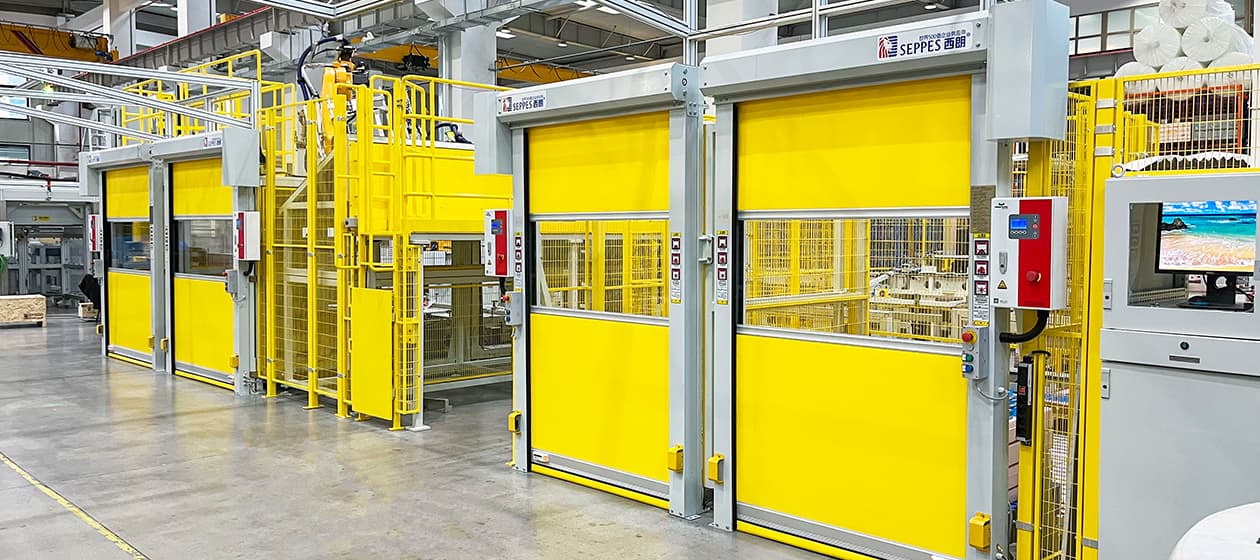
Dust and uncontrolled airflow between production zones can affect product quality, working conditions and process stability. The most practical solution is to combine a properly configured high-speed roll-up door with suitable sealing, automatic activation and the facility's ventilation or pressure-control system. A SEPPES high-speed door reduces the time an opening remains exposed during personnel, forklift and material movement. Fast opening and automatic closing help limit uncontrolled air exchange between adjacent areas while maintaining efficient production flow.
Quick answer
How can a factory control dust and airflow between production zones?
Use a correctly sized high-speed roll-up door to shorten the time adjacent zones remain openly connected, then coordinate its seals, activation zone and closing delay with the facility's extraction, filtration and pressure-control systems. The door supports environmental separation; it does not replace those systems.- Primary function
- Shorter open time
- Traffic fit
- People, forklifts & AGVs
- Control focus
- Activation + closing logic
- System boundary
- Supports HVAC & extraction

Why open doorways create dust and airflow problems
Air naturally moves between areas with different temperatures and pressure levels. When an internal doorway remains open, dust, fumes, odours and untreated air can move with it.
In these conditions, the doorway becomes part of the production process. Selecting the wrong door—or operating without an automatic door—can create a repeated break in the environmental separation between zones.
- Forklifts pass through the same opening frequently
- Materials are transferred between processing and packaging areas
- One production zone generates more dust than another
- Adjacent rooms operate at different temperatures
- Ventilation systems maintain positive or negative pressure
- Operators leave conventional doors open to avoid waiting

How a high-speed roll-up door supports zone separation
The main advantage of an industrial rapid door is not simply its operating speed. It is the combination of fast movement, automatic access and controlled closing.
When a vehicle or operator approaches, the door receives an activation signal and opens. After the passage is clear, it closes automatically. This creates a shorter and more predictable exposure period than a doorway that depends on manual operation.
Shorter open time
A fast opening and closing cycle reduces the duration of uncontrolled air exchange. This is particularly important at doorways used throughout a production shift.
The actual door speed and closing delay should be configured according to the opening size, vehicle type, traffic frequency and safety requirements. Maximum speed should not be treated as the only selection criterion.

Improved perimeter sealing
The door curtain, guide structure and bottom edge should work together to reduce unnecessary gaps around the opening.
For dust-control applications, the sealing design should be evaluated against actual site conditions, including floor level, air-pressure difference and dust characteristics. A well-fitted industrial door can support separation more effectively than a door selected only by nominal dimensions.

Automatic closing
Doors are often left open because manual operation interrupts the workflow. Radar sensors, pull cords, push buttons, remote controls or production-system signals can activate the door automatically.
Automatic closing helps ensure that the doorway returns to its separated state after each passage instead of remaining open for convenience.
Controlled access
Different activation methods can be assigned to personnel, forklifts or automated equipment. This prevents unnecessary opening and allows the door cycle to follow the real traffic pattern.
For example, a forklift route may require directional radar or loop detection, while a personnel passage may use a push button or access-control signal.

Where dust-control high-speed doors are commonly used
High-speed roll-up doors are suitable for internal production openings where environmental separation and frequent access must be balanced.
Each application has different requirements. A food-processing doorway may prioritize cleanability and separation, while a manufacturing workshop may focus on forklift flow, dust migration and equipment integration.
- Processing and packaging zones
- Raw-material and finished-product areas
- Production and warehouse connections
- Dust-generating and cleaner working zones
- Temperature-controlled workshops
- Electronics and precision manufacturing areas
- Pharmaceutical and daily-chemical facilities
- Food and beverage processing facilities
- Automotive and equipment manufacturing plants
- Conveyor and automated material-transfer openings

Choosing the right activation method
The activation system directly affects both traffic efficiency and environmental control. If a sensor detects too large an area, the door may open when no passage is required. If the detection range is too narrow, forklifts may need to slow down or stop. Both situations reduce the effectiveness of the doorway.
The most suitable solution depends on the direction of traffic, approach speed, available stopping distance and whether pedestrians and vehicles share the route.
- Radar sensors for approaching vehicles or personnel
- Magnetic loops for forklift routes
- Pull cords for operator-controlled access
- Push buttons for controlled personnel passage
- Remote controls for designated users
- Access-control devices for restricted areas
- I/O or communication interfaces for production equipment

Connecting the door with the production workflow
In modern factories, an industrial rapid door may need to operate as part of a larger production system.
For openings between areas with different cleanliness or pressure requirements, two doors may be interlocked so that one door cannot open until the other has closed. This arrangement can provide more controlled separation than a single exposed doorway.
Signal requirements and operating logic should be confirmed before production. This allows the control system, safety devices and site equipment to be planned as one coordinated entrance solution.
- Conveyors
- Automated guided vehicles
- Machine safety systems
- Access-control systems
- Warning lights and alarms
- Air curtains
- Interlocked door systems
- Building or production control systems

Safety must be considered with speed
A high-speed door should improve production flow without creating additional risk. Depending on the doorway and traffic conditions, the safety configuration may include photocells, safety edges, warning devices or other presence-detection measures.
The goal is not simply to make the door move faster. It is to create a controlled, repeatable and safe access sequence.
- Pedestrian and forklift traffic
- Vehicle height and approach direction
- Opening dimensions
- Visibility around the doorway
- Frequency of operation
- Emergency procedures
- Connection with surrounding equipment

What to confirm before requesting a door solution
Providing accurate site information helps the manufacturer recommend a more suitable configuration.
Photos, drawings and a short video of the traffic route can also help identify installation limitations that may not appear in the opening dimensions alone.
- Clear opening width and height
- Whether the door is installed indoors or outdoors
- Types of traffic passing through the opening
- Estimated daily operating frequency
- Main dust or airflow-control objective
- Temperature or pressure difference between zones
- Required activation method
- Available installation space
- Safety and access-control requirements
- Signals required from conveyors, AGVs or other equipment

Why SEPPES for production-zone access
SEPPES develops industrial entrance solutions for factories, warehouses and logistics facilities. Its high-speed door systems can be configured around opening conditions, traffic patterns, environmental separation and automation requirements.
Rather than treating a rapid door as an isolated piece of equipment, SEPPES focuses on the complete access point: the door structure, drive system, safety sensing, activation logic and connection with the customer's production process.
This project-based approach supports SEPPES's position as a mid-to-high-end Chinese industrial door brand. The objective is to provide international buyers with a reliable alternative for demanding industrial applications and to compete through product configuration, manufacturing capability, engineering support and long-term application value.

Build a more controlled production route
Controlling dust and airflow between production zones requires more than installing the fastest available door. The right solution combines a suitable high-speed roll-up door with effective sealing, reliable safety sensing, appropriate activation and coordinated production controls.
If your facility has a frequently used opening between processing, packaging, warehouse or temperature-controlled areas, SEPPES can evaluate the doorway and recommend an industrial rapid-door configuration based on the actual operating conditions.
Send us the opening dimensions, application, traffic type and site photos. Our team will help you plan a high-speed door solution for more efficient access and more consistent environmental separation.
Dust and Airflow Control Questions
Can a high-speed door completely stop dust?
No door should be presented as a complete dust-control system. A high-speed door helps reduce transfer by shortening open time and improving doorway separation, while extraction, filtration and pressure control address the wider air-management requirement.
Is a high-speed roll-up door suitable for forklift traffic?
Yes, when the opening size, activation method, detection zone, visibility and safety devices are configured around the actual forklift route and site conditions.
Can the door work with an air curtain?
Yes. The rapid door and air curtain can be coordinated where the application requires additional airflow management. Their operating sequence should be confirmed during project design.
Can two rapid doors be interlocked?
Yes. Interlocking can help prevent two controlled boundaries from remaining open at the same time. The sequence, safety release and fault response must be defined for the site.
What project information is needed?
Provide the opening dimensions, quantity, traffic type, operating frequency, environmental objective, pressure or temperature difference, control requirements and available site photos or drawings.
Related solution