
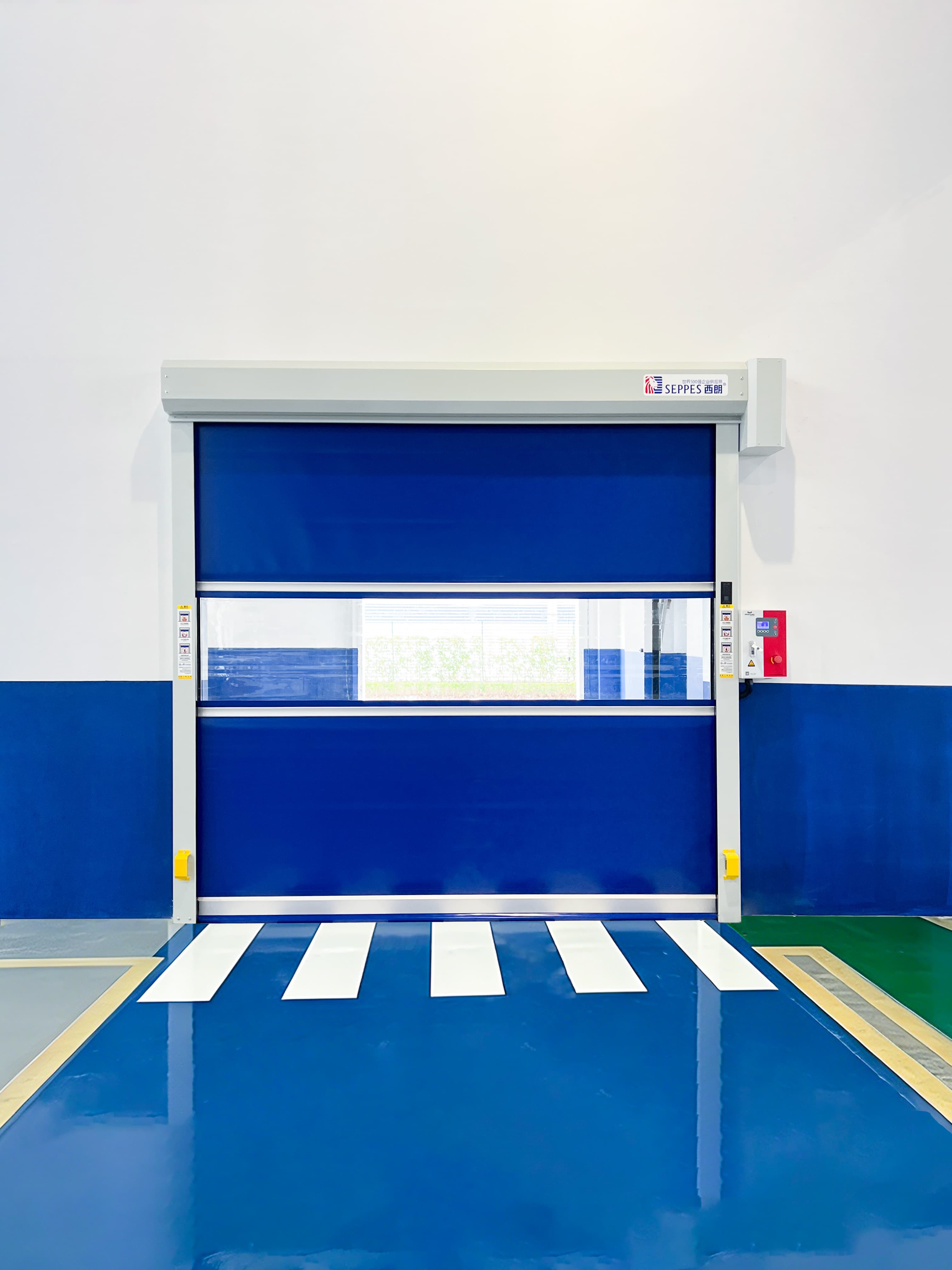
For busy internal production areas, a high-speed roll-up door is a practical choice when the priorities are frequent access, shorter waiting time and controlled separation. The SEPPES PVC rapid door combines 0.6–1.5 m/s opening speed, safety sensing and configurable controls in one entrance system designed around the real traffic pattern.
Quick answer
Is a high-speed roll-up door right for a busy production area?
Yes—when frequent access, shorter waiting time and controlled separation are the priorities. Final speed, size, safety devices and controls should be configured around the verified opening and traffic pattern.- Opening speed
- 0.6–1.5 m/s
- Maximum size
- 5.8 × 6.0 m
- Standard safety
- Infrared photocell
- Control options
- I/O + RS-485

Why busy production areas need a faster doorway
A conventional door can become a repeated bottleneck when forklifts, operators and material carts share the same route. Slow operation creates queues, while a doorway left open for too long allows conditioned air, dust, odours or insects to move between adjacent zones.
A high-speed roll-up door reduces the open interval without asking the production team to operate the door manually. The benefit is not speed in isolation: it is a more predictable movement sequence between production, packaging and warehouse areas.

What the new-generation SEPPES door brings together
Reliable high-frequency movement depends on the complete entrance system. The FROG PUPIL variable-frequency controller coordinates the motor and selected activation method, while the flexible PVC curtain provides a lightweight separation surface. Transparent vision sections can improve awareness across a shared route.
Dense nylon side brushes guide the curtain and help limit uncontrolled air exchange around the tracks. Aluminium wind-resistance bars reinforce the curtain for the operating conditions defined in the proposal. Together, these components support controlled opening, closing and separation throughout the working shift.
- 0.6–1.5 m/s opening speed for frequent internal traffic
- 0.8 mm PVC curtain with a 1.2 mm clear vision panel in the standard reference configuration
- Dense nylon side brushes and aluminium wind-resistance bars
- Autonics infrared photocell protection across the passage
- Reserved I/O terminals and RS-485 communication for agreed automation interfaces

Choose activation around the way traffic approaches
The opening device should match the workflow. Radar supports hands-free approach detection, a pull cord gives forklift drivers deliberate control, and an induction loop can identify vehicles within a defined ground area. Access control is useful where only authorized movement should trigger the door.
The correct detection zone opens the door early enough for smooth travel but avoids unnecessary cycles caused by nearby movement. Mixed pedestrian and vehicle traffic may require additional sensing, barriers or route management after a site-specific safety review.

Connect the door with the production workflow
A busy entrance may need to respond to more than a person or forklift. Reserved I/O terminals and RS-485 communication allow agreed signals from access-control equipment, AGVs, conveyors or production machinery to be considered during project design.
Interface requirements should be documented before production, including the signal type, opening permission, closing logic, fault response and responsibility for commissioning. This turns a standalone door into a coordinated part of the facility rather than an isolated device.

What to confirm before requesting a quotation
A dependable proposal starts with the finished opening, available side room and headroom, traffic direction, operating frequency and environmental-separation target. Photos or drawings help identify pipes, columns, conveyors and protective barriers around the opening.
The final proposal should state the curtain type, colour, vision section, opening method, safety devices, motor position, power supply and control interfaces. SEPPES follows a mid-to-high-end brand route built around application-based engineering, consistent manufacturing and responsive project support—not low-price competition.
- Finished opening width and height, quantity and project location
- Pedestrian, forklift, AGV or equipment traffic pattern
- Expected cycles per hour and per day
- Dust, insects, temperature, wind or pressure conditions
- Button, radar, pull cord, induction loop or automatic signal
- Available site photos, drawings and automation requirements

High-Speed Roll-Up Door Questions
What is a high-speed roll-up door?
It is a rapid industrial door with a flexible curtain, designed for frequent opening and closing at production, warehouse and logistics passages.
Is it suitable for forklift traffic?
Yes. The opening size, activation method, detection zone, visibility and safety devices must be selected around the forklift route and site conditions.
How fast does the SEPPES door open?
The product reference range is 0.6–1.5 m/s. Final operating speed is confirmed according to door size, traffic pattern and project configuration.
Can it connect with an AGV or production line?
The control design reserves I/O terminals and RS-485 communication for agreed automation interfaces. Signal logic should be confirmed before production.
What is needed for a quotation?
Send the opening width and height, quantity, application, traffic type, operating frequency, project location, controls and available photos or drawings.
Related solution